



Article 3 min read
Early project start: why costs before the application are lost


Funding is meant to make a project possible. That is why costs are usually only eligible if the project starts after the application. Even a signed order can count as the start and put funding for the entire project at risk.
The machine has been ordered, the new developer hired, work is under way. Now the funding application is to follow. In many cases it is already too late.
The reason is a principle that applies to almost all funding programmes: funding must create an incentive. This article explains what that means and where the typical pitfalls lie.
The principle: funding must create an incentive
Public money is meant to enable projects that would not take place, or not on this scale, without funding. EU state aid law calls this the incentive effect. It is considered present if the application is submitted before work on the project starts.
If you have already started, from the funding body’s perspective you have shown that the project will happen without funding. The consequence: funding is at risk not only for the costs before the application, but often for the entire project.
What counts as the start and what does not
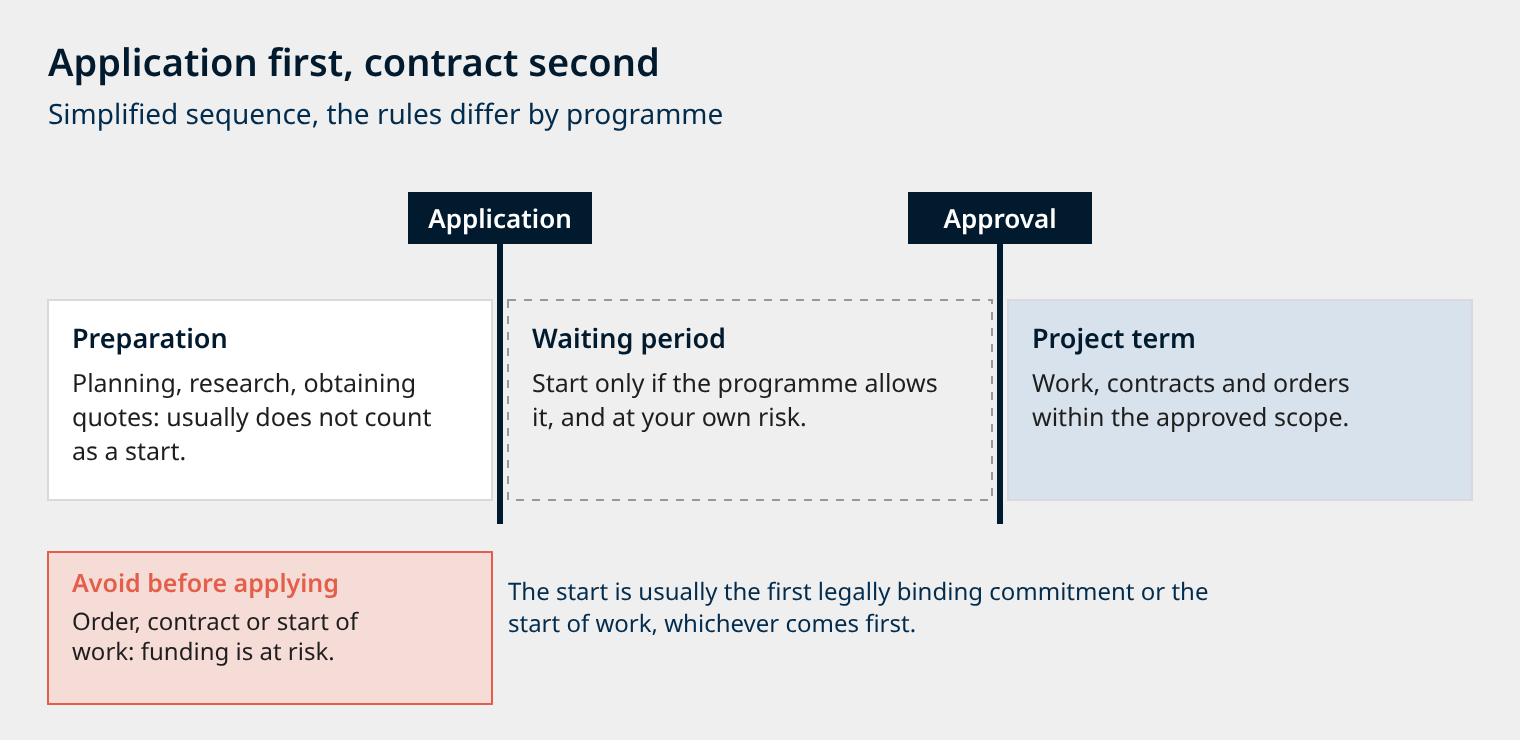
The start is usually the beginning of work or the first legally binding commitment, such as an order or a signed contract, whichever comes first.
Preparatory steps usually do not count as the start. These include planning, research, obtaining quotations or feasibility studies. Each programme sets out the exact boundaries itself.
Typical pitfalls
In practice it is rarely about deliberate violations, but about routines that are normal in day-to-day business:
- Ordering in advance: hardware with long delivery times is ordered early so that it is there when the project starts.
- New hires: someone is hired specifically for the planned project and starts working.
- Contracts with service providers: a development partner is commissioned early to avoid losing time.
Between application and decision
It often takes months from application to decision. Some programmes allow you to start at your own risk during this time. Others require explicit consent from the funding body. Neither creates a right to funding. If the application is rejected, you bear the costs yourself.
Programmes differ
The rules on the start of a project are not the same everywhere. Always check the guideline of the programme concerned and, if in doubt, ask the funding body before the first order.
Conclusion
The simplest rule is: application first, then orders. Some programmes even require the grant decision or explicit approval before the first order. If you want to use funding, plan it before entering into the first commitments. In our funding advisory we help align the timeline between application, commissioning and project start early on.
Frequently asked questions
Can I start the project before the funding decision?
That depends on the programme. Some allow you to start after applying at your own risk, others require explicit consent. Neither creates a right to funding.
Does a quotation already count as an order?
Requesting quotations is usually harmless. It becomes critical as soon as you accept a quotation or sign a contract.
Are the costs of preparing the application eligible?
In many programmes they are not. They arise before the project and are therefore usually not part of the eligible costs.
Sources
This article is for general information only. It does not replace legal or tax advice on individual cases. The applicable guidelines, funding decisions and statutory provisions in their current version are authoritative.
Compenio editorial team