



Article 3 min read
Undertaking in difficulty: when losses rule out public funding


Companies that qualify as undertakings in difficulty under EU state aid law cannot receive funding in most programmes, no matter how good the project is. Growing technology companies with accumulated losses are particularly affected once they are more than three years old.
A technology company has been developing a new product for years. Development has cost money and the balance sheet shows losses. Now a funded project is supposed to finance the next step. And this is exactly where it can fail, before the project is even evaluated.
The reason is a term from EU state aid law: the “undertaking in difficulty”. This article explains what lies behind it and how to recognise a risk early.
What the term means
Most funding programmes for companies are based on the EU General Block Exemption Regulation (GBER). It generally excludes undertakings in difficulty from aid. The idea: public money should promote innovation, not support companies whose survival appears to be at risk.
What counts is not how the company is actually doing. Fixed criteria apply, derived from the balance sheet and legal situation.
The criteria explained
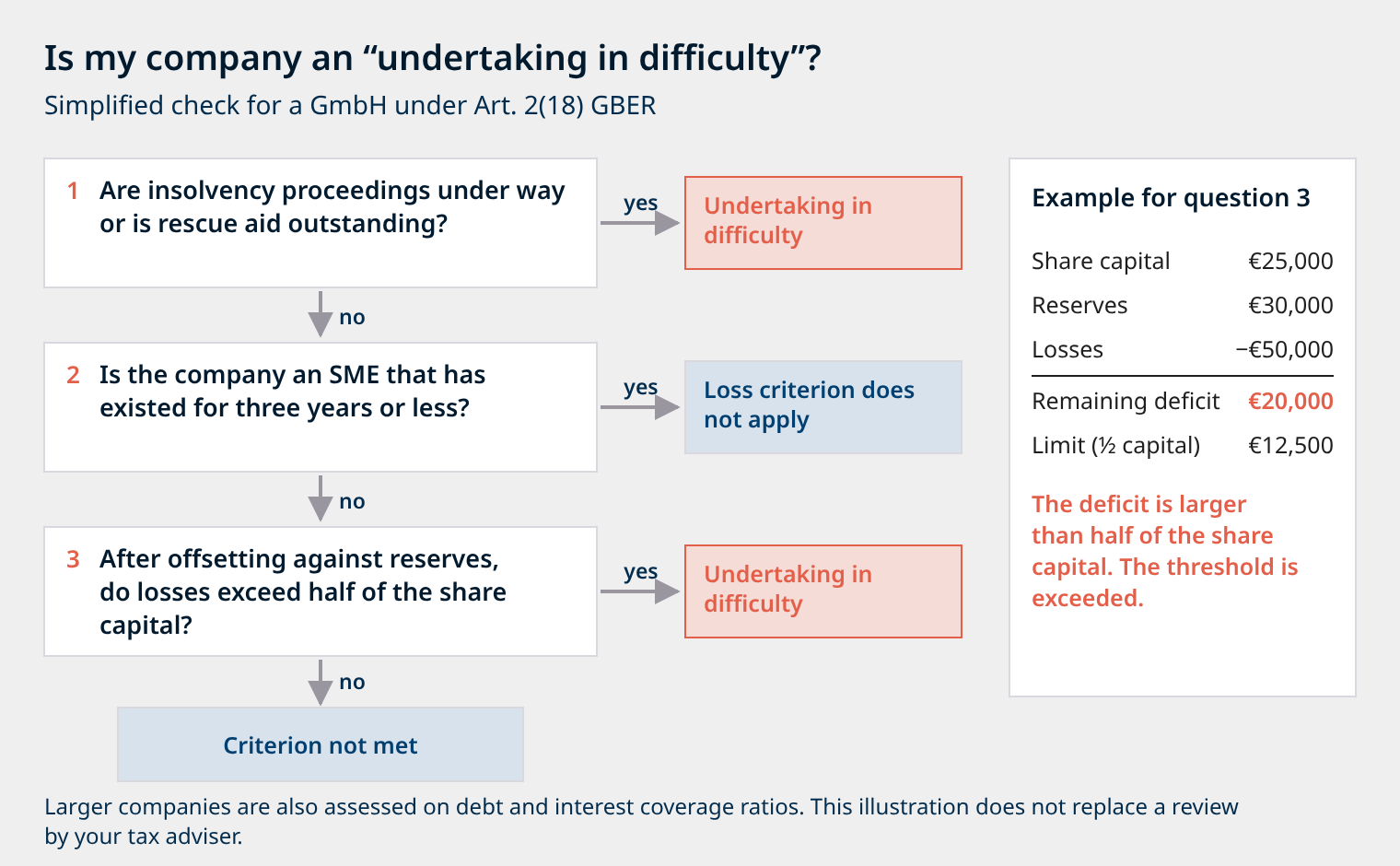
For a limited liability company one criterion matters most: a company is in difficulty if more than half of its subscribed share capital has disappeared as a result of accumulated losses. Put simply, the losses are offset against reserves and other own funds. If the remaining deficit exceeds half of the share capital, the threshold is crossed.
There are other cases too, such as ongoing insolvency proceedings or rescue aid that has not been repaid. For larger companies, additional ratios on debt and interest coverage apply. The full definition is in Art. 2(18) GBER.
Who is exempt
Small and medium-sized enterprises that have existed for less than three years are not considered undertakings in difficulty, even if they report high losses. This exemption ends with the third year after incorporation.
Why technology companies in particular are affected
Developing new technologies often means investing for years before significant revenue arrives. Losses are normal in this phase and not a warning sign for investors. State aid law, however, makes no such distinction. Young companies that have just passed the three-year mark are often caught by surprise.
How to recognise a risk
A closer look is worthwhile if several of these points apply:
- Your company is more than three years old.
- The balance sheet shows accumulated losses that are growing significantly.
- Equity is low or negative relative to share capital.
- Financing comes mainly from shareholder loans.
- A financing round is planned but not yet closed.
What you can do
Review the situation together with your tax adviser before applying. Whether and how the equity position can be improved depends on the individual case and should be agreed from a tax and legal perspective. Timing is key: measures usually only take effect with the next annual accounts.
Conclusion
A good project alone is not enough if the balance sheet formally classifies the company as an undertaking in difficulty. Checking this early avoids rejected applications and lost time. Such a preliminary check is part of our funding advisory.
Frequently asked questions
Do shareholder loans count as equity?
That depends on how they are structured and programmes treat them differently. Clarify this with your tax adviser and, if necessary, directly with the funding body before you apply.
Is this only checked at the time of application?
It is usually checked before approval. Many programmes also require you to report significant changes during the project, so the financial situation remains relevant.
Which annual accounts are relevant?
Usually the most recent approved annual accounts. Some funding bodies also ask for current figures, such as an interim management report.
Sources
This article is for general information only. It does not replace legal or tax advice on individual cases. The applicable guidelines, funding decisions and statutory provisions in their current version are authoritative.
Compenio editorial team