



Article 3 min read
SME status: how shareholdings and investors change your classification


Whether a company counts as an SME determines funding rates and access to many programmes. What matters is not only its own headcount and turnover, but also those of shareholders and holdings. After a financing round, the classification often changes unnoticed.
“But we are small.” We hear this often, and usually it is true. For funding programmes, however, what counts is not the impression but the EU definition. And it looks not only at the company itself, but also at its owners and holdings.
This article explains how SME status is determined and in which cases it changes unexpectedly.
Why SME status matters
Small and medium-sized enterprises receive higher funding rates in many programmes. Some programmes are open exclusively to SMEs. An incorrect classification can therefore mean lower funding than planned or none at all. Funding bodies check the status themselves and may reach a different conclusion than the company.
The thresholds
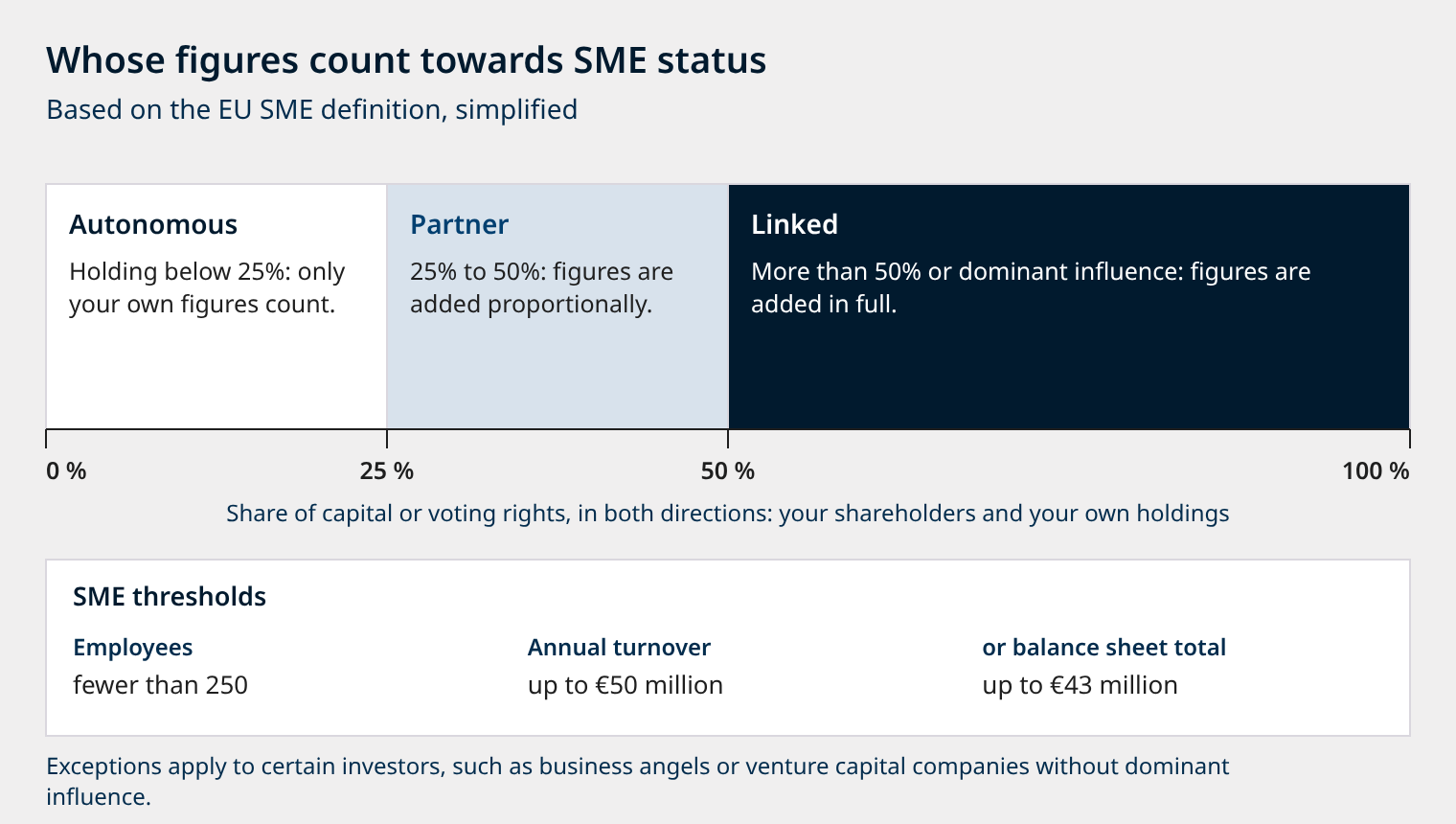
A company is an SME if it employs fewer than 250 people and has either an annual turnover of no more than EUR 50 million or a balance sheet total of no more than EUR 43 million. Within SMEs there is a further distinction: small enterprises have fewer than 50 employees and no more than EUR 10 million in turnover or balance sheet total.
So far, so clear. It gets complicated with the question of whose figures are included.
Autonomous, partner or linked
The EU definition distinguishes three cases:
- Autonomous: no other company holds 25 % or more in your company, and your company holds no such stake either. Then only your own figures count.
- Partner enterprise: a holding lies between 25 % and 50 %. The partner’s figures are added proportionally.
- Linked enterprise: a company holds more than 50 % or can control the other. The figures are added in full.
This applies in both directions: to shareholders in your company and to holdings your company itself owns. Links through natural persons can also matter if the companies operate in the same or in adjacent markets.
Typical cases
Surprises often arise in these constellations:
- The founder holds her shares through a holding company that has stakes in other companies.
- A strategic investor takes a majority or receives extensive control rights.
- The same shareholders run several companies that work together.
Exceptions for certain investors
The definition provides exceptions. Certain investors such as public investment corporations, venture capital companies, business angels up to a certain investment amount or universities may hold up to just under 50 % without the company losing its autonomy, provided they do not exercise a controlling influence.
When the status changes
Exceeding the thresholds once does not change the status. Only when the limits are exceeded or undercut in two consecutive financial years does the new classification apply. Changes in ownership, on the other hand, can change the status immediately.
Conclusion
SME status often depends less on your own size than on the structure around it. If you are planning a financing round or a restructuring, you should know the impact on funding beforehand. Reviewing the company structure is part of the preliminary check in our funding advisory.
Frequently asked questions
Do apprentices count towards headcount?
No. Apprentices with an apprenticeship or vocational training contract are not counted under the EU definition. Part-time staff count proportionally, employees on maternity or parental leave are not counted.
Which financial year is relevant?
The basis is the most recent approved accounts. Young companies without a completed financial year provide a good-faith estimate.
What happens if the status changes during the project?
The funding rate is usually based on the status at approval. If the company structure changes before approval, for example through a new investor, you should inform the funding body.
Sources
This article is for general information only. It does not replace legal or tax advice on individual cases. The applicable guidelines, funding decisions and statutory provisions in their current version are authoritative.
Compenio editorial team