



Article 3 min read
Own contribution and pre-financing: when the funding actually arrives


An approved grant is not money in the bank. Most funding programmes reimburse costs only after they have been paid and documented, and part of the funding often only after the final review. Companies therefore need to plan their own contribution and pre-financing from the start.
The funding decision has arrived and everyone is pleased. But nothing changes in the bank account at first. On the contrary: the first months of a funded project often consume more liquidity than expected.
This article explains why and what to consider when planning.
Pay first, document, then receive
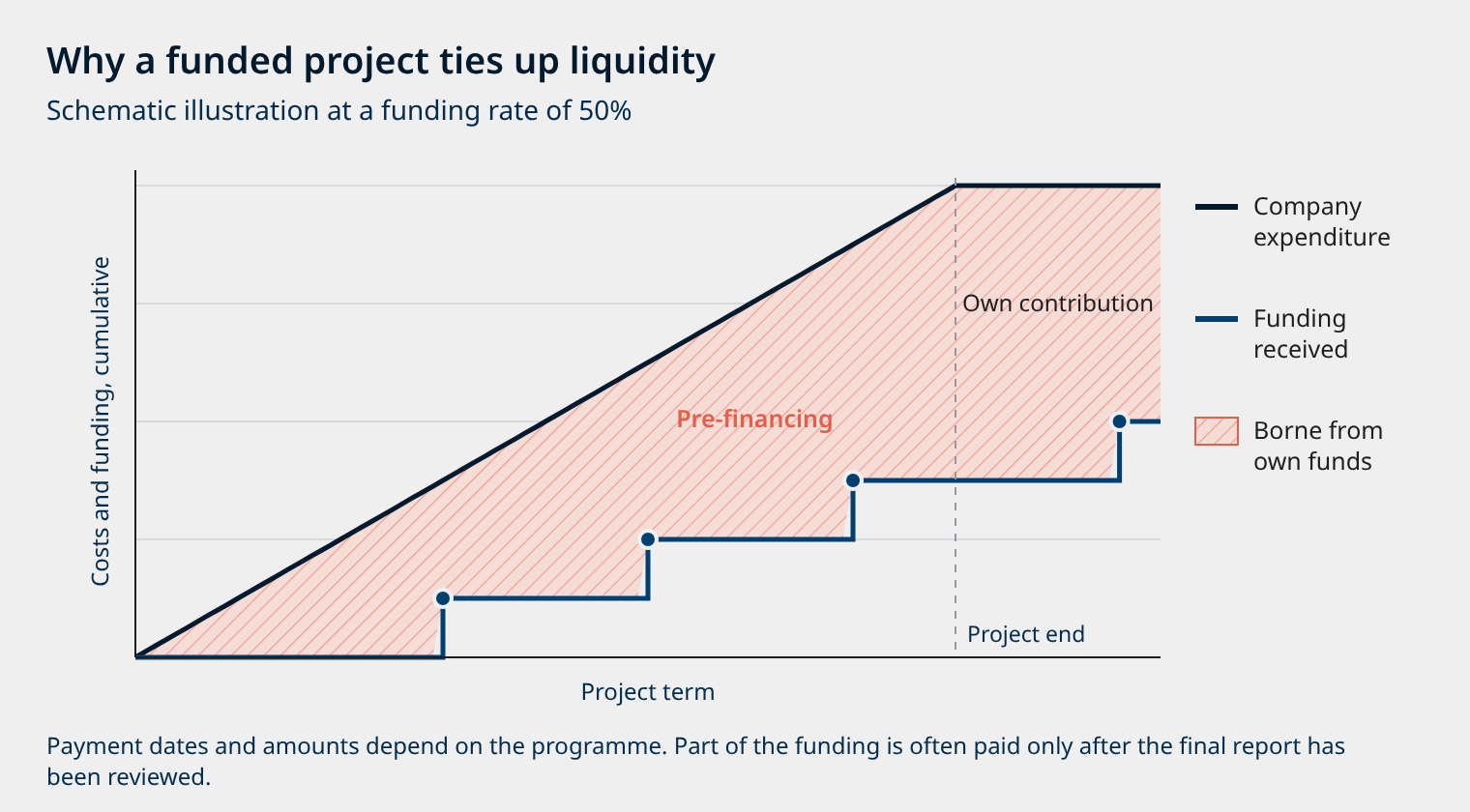
Many funding programmes for companies work on the reimbursement principle. As a company, you first pay salaries, materials and invoices yourself. Then you document the costs to the funding body and request payment. Only after the review does the money arrive.
There are therefore usually several months between the first expense and the first funding payment. During this time the company pre-finances the project entirely.
What the own contribution means
A funding rate of, say, 50 % means that the company bears half of the eligible costs itself. On top of that come costs that are not eligible at all, such as general equipment or sales. The actual own share of the total effort is therefore often higher than the funding rate suggests.
Why months pass between expense and reimbursement
Several factors extend the time until payment:
- Request intervals: payments are often requested at fixed intervals, not for each individual invoice.
- Review: every payment is reviewed. If documents are missing, payment is delayed.
- Retentions: part of the funding is often only paid after the final report has been reviewed at the end of the project.
What funding bodies want to see on financing
Many funding bodies check during the application process whether the company can finance the project. Typical questions concern annual accounts, current figures and how the own contribution is financed. A clear plan makes this review easier.
Warning signs
Pay particular attention to your liquidity if
- the project starts with large purchases,
- several funded projects run at the same time,
- large parts of the work are outsourced to service providers, or
- the company’s reserves are tight.
Conclusion
A funded project improves the financing of a development, but with a time lag. Planning your own contribution and pre-financing realistically before applying avoids bottlenecks during the project. As part of our project support we keep payment requests and documentation on track so that the money arrives as quickly as possible.
Frequently asked questions
Are advance payments available?
Some programmes pay on request for expenses that fall due shortly. Many programmes for companies, however, work on a reimbursement basis. The funding decision states which applies.
Can the own contribution be financed with a loan?
In many cases yes. The funding body will want to see that overall financing is secured, so a loan should be committed before the project starts.
What if money gets tight during the project?
Talk to the funding body early. Schedules can often be adjusted. Quietly postponing work, by contrast, risks deviations from the work plan that have to be explained later.
Sources
This article is for general information only. It does not replace legal or tax advice on individual cases. The applicable guidelines, funding decisions and statutory provisions in their current version are authoritative.
Compenio editorial team