



Article 4 min read
Research allowance: who is eligible and how the procedure works


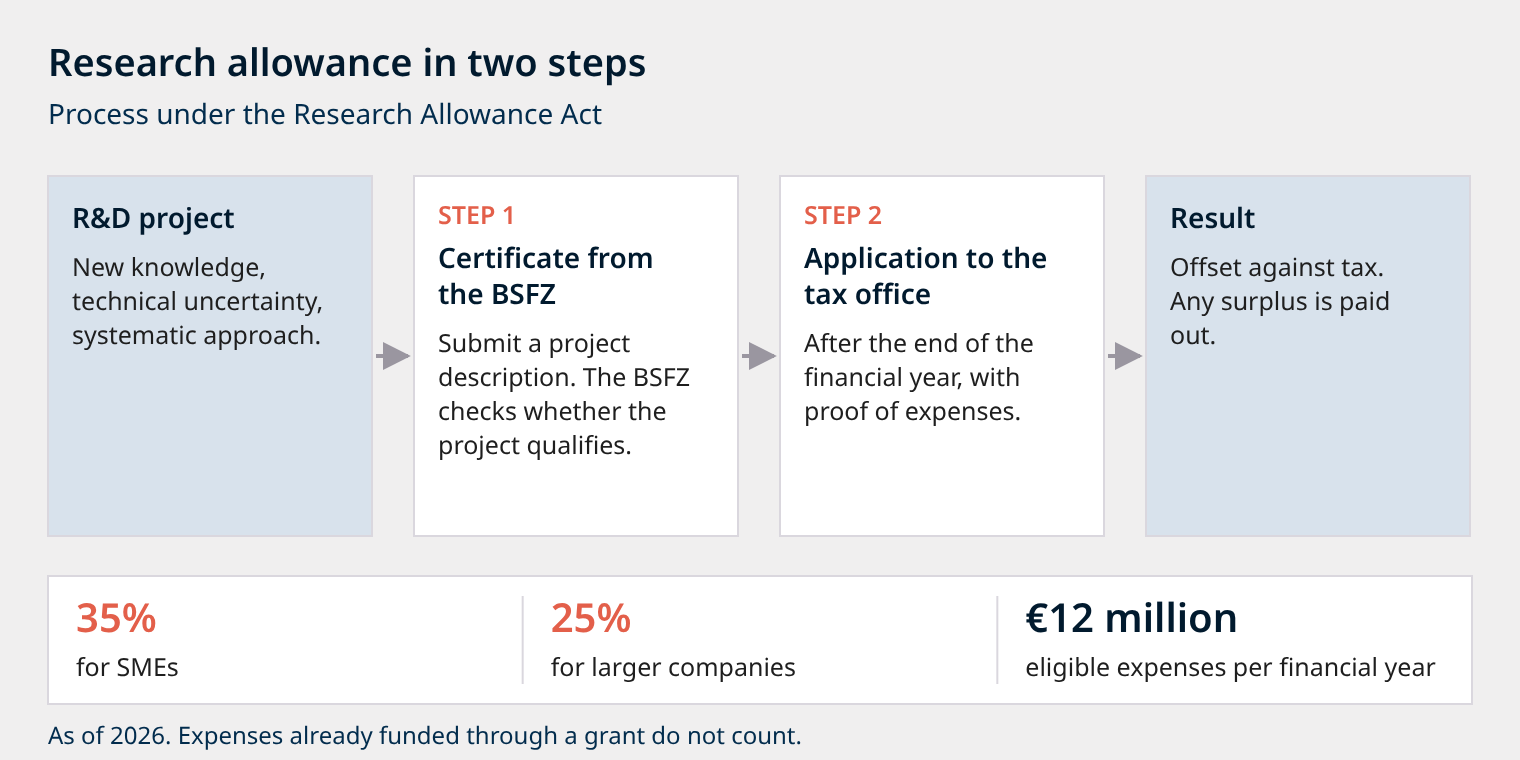
The German research allowance (Forschungszulage) refunds 25 percent of eligible R&D expenses, and 35 percent for small and medium-sized enterprises. It is open to every company with tax liability in Germany and is claimed in two steps: a certificate from the BSFZ, then an application to the tax office.
Many companies develop new products and processes without using the research allowance. Often this is because they assume it is only intended for large research departments or specific industries. The opposite is true: the German research allowance (Forschungszulage) is open to all companies with tax liability in Germany, regardless of industry, size or funding calls.
This article explains which projects qualify, how high the research allowance is and how the two-step procedure works.
Who is eligible for the research allowance
The legal basis is the Research Allowance Act (Forschungszulagengesetz, FZulG). Companies with tax liability in Germany that carry out an eligible research and development project are entitled to it. There are no deadlines and no limited budgets: anyone who meets the requirements receives the allowance. The project does not have to be a funded project. Self-financed development work counts as well. Only expenses already funded through a grant are excluded.
Eligible are fundamental research, industrial research and experimental development. What matters is that the project creates new knowledge, involves technical uncertainty and is carried out in a planned manner. The further development of an existing product can qualify if it goes beyond the state of the art. Routine work, simple adaptations and market research do not count.
How high the research allowance is
The research allowance amounts to 25 percent of eligible expenses, and 35 percent for small and medium-sized enterprises. Since 2026, eligible expenses of up to EUR 12 million per financial year are taken into account.
| Company | Rate | Eligible expenses per financial year |
|---|---|---|
| Small and medium-sized enterprises | 35 % | up to EUR 12 million |
| Larger companies | 25 % | up to EUR 12 million |
The allowance is offset against income or corporate tax. If it exceeds the tax liability, the remainder is paid out. This makes it worthwhile for young companies that are not yet profitable.
Step 1: Certificate from the BSFZ
First, the certification body for the research allowance (Bescheinigungsstelle Forschungszulage, BSFZ) checks whether the project qualifies in terms of content. To do this, you submit a project description. It must clearly set out what is new, which technical risks exist and how the project is planned.
The quality of this description determines the outcome. A clear structure has proven effective: starting point and state of the art, objective and novelty, uncertainties, work plan. A search of the state of the art helps to substantiate the novelty.
Step 2: Application to the tax office
With the certificate, you apply for the research allowance at the tax office, each time after the end of a financial year. You provide evidence of the eligible expenses, above all the personnel costs of the employees involved in the project.
Clean documentation is important for this step: who worked how many hours on the project, and which expenses were incurred? You usually file the application together with your tax adviser.
Common mistakes
- Project description too general: without a concrete technical question, the novelty cannot be assessed.
- Missing time records: project hours that are not documented are hard to prove later.
- Double funding: expenses that are already covered by a grant do not belong in the research allowance.
- Missed years: past financial years can only be claimed while the assessment period is still open, generally four years.
Conclusion
For many companies, the research allowance is the simplest form of R&D funding: no deadlines, no competition for budgets, and retroactive claims are possible. Companies that document their projects early and substantiate the novelty properly can recover a considerable part of their development costs.
Frequently asked questions
Can the research allowance be claimed retroactively?
Yes. The research allowance can be claimed for past financial years as long as the tax assessment period is still open, generally four years. A BSFZ certificate for the project concerned is required.
Can the research allowance be combined with grants?
Yes, provided the same expenses are not funded twice. Costs that are already subsidised under a funding programme cannot also be included in the research allowance.
Does the project have to be completed?
No. The BSFZ certificate can be applied for before, during or after the project. The application to the tax office is filed after the end of the financial year for the expenses incurred in that year.
Sources
This article is for general information only. It does not replace legal or tax advice on individual cases. The applicable guidelines, funding decisions and statutory provisions in their current version are authoritative.
Compenio editorial team